31.03.2017
NLP Technique: Bringing Something New Into Your Life in 5 Steps

This NLP technique helps you tune in to a new outcome and start noticing things that used to pass you by. It works well for small changes — for example, when you want more excitement, new encounters, fresh ideas, or momentum in your work or a personal project.
The idea is simple. You choose an outcome, imagine it as though it has already happened, and then carry that feeling into the present. Before the exercise, it helps to understand what NLP actually is and why it pays so much attention to images, sensations, and inner focus.
When This NLP Technique Fits
The exercise works well for goals where attention, readiness to act, and openness to new options matter. Finding a new source of inspiration. Going back to studying. Noticing the right opportunity. Starting to connect with people more. Bringing into your life something you don’t have a clear plan for yet, but already want.
For bigger goals, it’s worth first checking how the outcome is worded. It should be specific, ecological, achievable, and dependent on your own actions. If you’d like a broader view of the topic, there’s a related article, “NLP Practices and Techniques.”
Step-by-Step Guide to the NLP Technique “Bringing Something New Into Life”
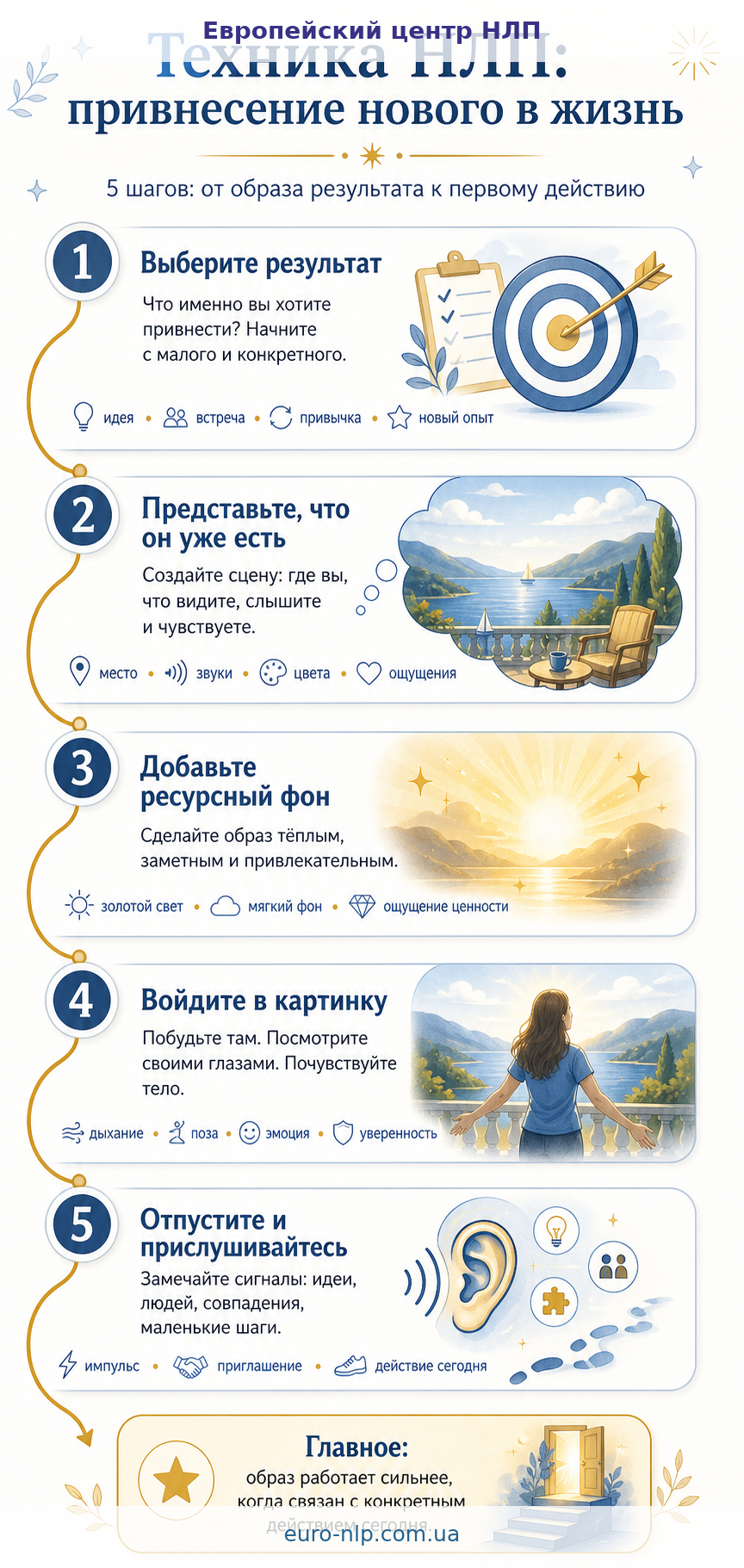
Step 1. Choose an Outcome
First, decide exactly what you want to bring into your life. For the first time, it’s better to pick something small — not “completely change my fate,” but, say, finding a new idea for a project, meeting an interesting person, or rekindling your interest in something you do.
Check yourself. What do I want to get? How will I know it has appeared? What will I see, hear, or feel once the outcome is already close?
Step 2. Imagine the Outcome Already Exists
Close your eyes and create a picture of the outcome — not a vague idea, but a scene. Where are you? What’s around you? What colors, sounds, movements are there? What’s happening in your body? The more vivid the picture, the easier it is for your brain to recognize similar opportunities in reality.
You can mentally step into the future where the outcome has already happened, take in that scene, and bring its feeling back with you into the present.
“Wonderful. A blue feather. Imagine the feather, visualize it — every line, every edge, the tip, the Y-shaped split where it’s torn, the down around the shaft.”
Step 3. Place the Image on a Golden Background
Now place the picture on a golden background. It can be sharp or slightly blurred, as in some versions of the “swish pattern” technique. What matters here isn’t the color itself, but how it changes the feeling the image gives you. The outcome becomes warmer, more noticeable, more appealing.
If gold doesn’t feel right to you, choose another resourceful background. The main thing is that the image starts to pull you toward it, rather than staying just a picture in your head.
Step 4. Associate Into the Outcome
Step inside the picture. Look at the situation through your own eyes. Hear the sounds. Feel your body. Stay there for a few seconds, as if the outcome has already become part of your life.
If it’s hard to believe in the image right away, first look at it from the outside. Then still try to step inside, even briefly. What matters in this technique is the moment when the outcome stops being a picture “somewhere out there.”
Step 5. Let Go of the Picture and Start Noticing Opportunities
Open your eyes and let go of the image. From here, there’s no need to sit and wait for everything to happen on its own. It’s better to watch for small signals — ideas, invitations, people, coincidences, inner impulses, simple things you can do today.
Sometimes the outcome arrives quickly. Sometimes it takes time. Either way, after the exercise it helps to stay more attentive to anything connected to your chosen goal.
How to Strengthen the Effect of the Exercise
After the visualization, write down one next step — who to reach out to, what to look into, where to go, what to do today in 10 minutes. This way the image gets connected to real behavior instead of staying a pleasant fantasy.
If you’re looking for more than a one-off technique — for systematic work with states, beliefs, goals, and communication — you can check out the “NLP Practitioner” program or the article on where and how modern NLP is applied.