05.10.2015
Where NLP Is Applied: Fields and Practical Tasks
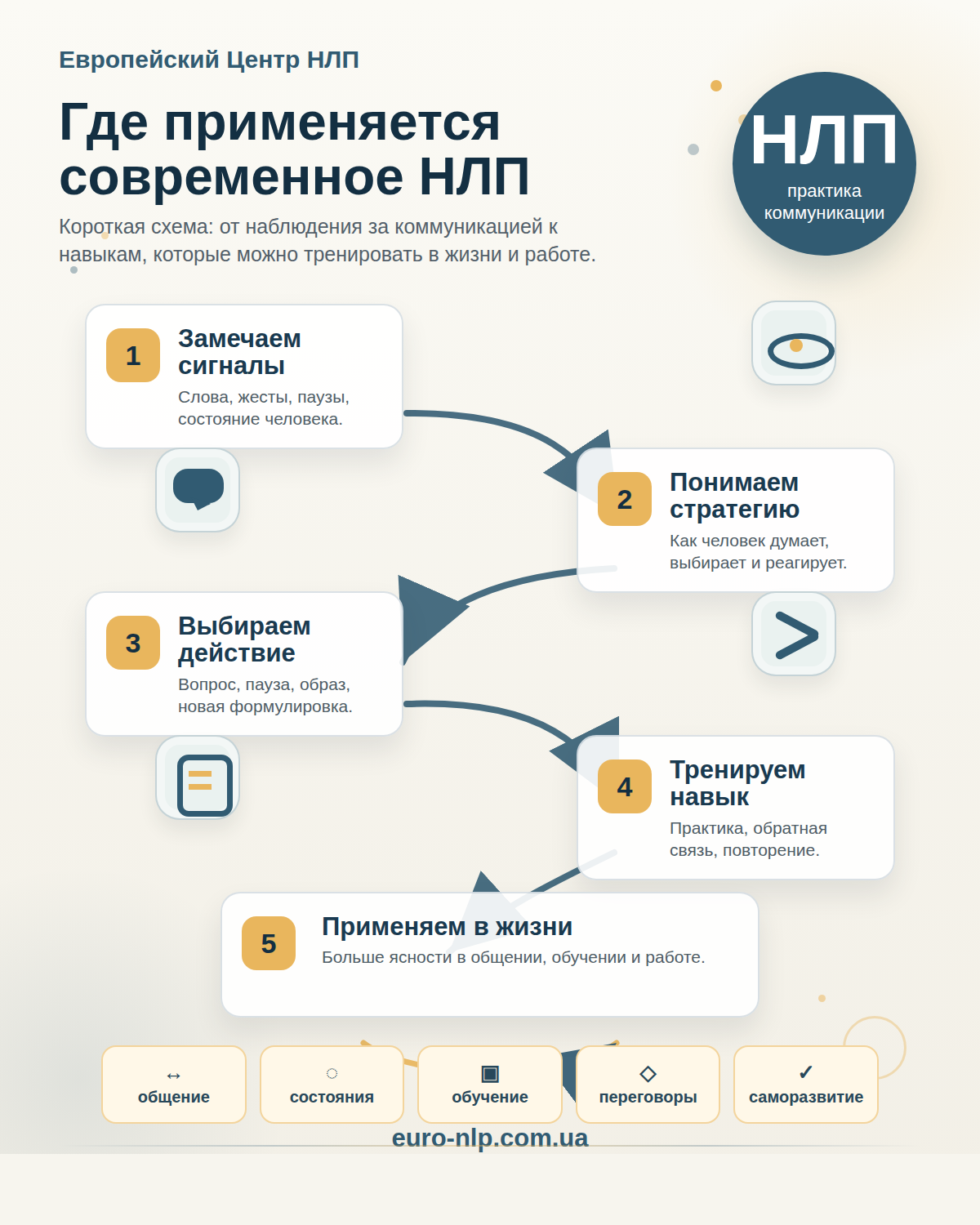
 Modern NLP is applied wherever a person needs to better understand themselves, other people, and the process of communication itself. That can mean training, negotiation, sales, public speaking, counseling, team management, or personal work with habitual reactions.
It’s important to look at NLP soberly. It’s not a magic button, and it’s not a set of phrases for pressuring people. In good training, NLP works as a practical language of observation: what a person says, how they react, which states get triggered, where they lose flexibility, and what can be changed in their behavior.
Where NLP Is Applied Today
The main area where NLP is applied is communication. A person learns to notice more details in speech, intonation, gestures, the other person’s reactions, and their own state. As a result, conversations become more precise: fewer automatic conflicts, more clarity, and more choice.
- Communication and relationships. NLP helps you listen to the other person better, phrase your thoughts more precisely, and get through difficult conversations more calmly.
- Training. NLP techniques are used to make material easier to explain, hold attention, and connect new information to a person’s own experience.
- Sales and negotiation. What matters here is rapport, questions, handling objections, and the ability to understand a client’s real need.
- Public speaking. NLP helps you manage your state, speech, pauses, and the audience’s reaction.
- Personal development. NLP practices provide tools for working with goals, habits, fears, inner conflicts, and personal effectiveness.
- Psychological counseling. Some practitioners use NLP as part of their practice, especially when working with reactions, mental images, states, and personal strategies.
NLP in Psychology and Counseling
In counseling, NLP is most often used to work with specific reactions: anxiety about a situation, an unpleasant memory, fear, an internal stop signal, difficulty making a choice. The practitioner observes how a person encodes their experience: what they see internally, what they hear, what they feel, what words they use.
This approach doesn’t replace medical or psychotherapeutic help where that’s needed. But in the hands of a trained practitioner, NLP can be a useful set of techniques for changing emotional reactions and expanding behavioral choice.
NLP in Training and Personal Development
In training, NLP is valued for its practicality. A person reads the theory and immediately drills the skill: asking questions, noticing nonverbal cues, trying new phrasing, getting feedback, and adjusting the action again.
If you need a basic starting point, it helps to first understand what NLP is and how it works. After that, it’s easier to see why specific exercises, models, and techniques exist.
What Helps You Master the Practice
NLP is hard to master from books alone. Live practice matters: one person speaks, another observes, a third gives feedback. That’s why many people choose a course format, such as NLP Practitioner, where theory is immediately tested through exercises.
NLP in Business, Negotiation, and Sales
In business, NLP is applied not for manipulation but for more precise communication. A leader needs to understand people’s motivation. A salesperson needs to hear the client’s real need. A negotiator needs to notice where the other person agrees, hesitates, or gets defensive.
There’s a separate topic on applying NLP in business and training. It focuses more on work situations: negotiation, presentations, management, sales, and team interaction.
NLP in Public-Facing Professions
NLP can be useful for journalists, teachers, actors, lawyers, managers, and anyone who works with speech. In these professions, it’s important to quickly grasp context, maintain rapport, choose precise words, and manage the audience’s attention.
A speaker, for instance, works with the text of their talk, their state, voice, pauses, the audience’s reaction, and their own ability to stay composed. In this sense, NLP offers handy exercises for training flexibility.

How to Tell NLP Is Right for You
NLP is worth studying if live communication, precise questions, working with states, and hands-on skill development matter to you — especially if you want to learn the terminology, try exercises, make mistakes, get feedback, and gradually change habitual reactions.
If you’re unsure whether NLP is about pressuring people, it’s worth reading the separate breakdown “Is NLP Manipulation?” And if you’d like to jump straight into exercises, start with the article on NLP practices and techniques.