07.10.2015
What Is NLP and How Does It Work
NLP, or neuro-linguistic programming, is a practical approach to studying thinking, speech, and behavior. At its core is modeling: how a person achieves a result, what internal strategies they use, and how those strategies can be described so that others can learn them too.

Put more simply, NLP looks at human experience as a system. It includes words, images, sensations, habitual reactions, goals, context, and feedback. Once we understand this system, we can work with it more precisely: ask different questions, change how we perceive a situation, train a new skill, and listen to the other person better.
What NLP Is in Plain Terms
NLP grew out of observing highly skilled practitioners of psychotherapy and communication. Its founders studied exactly what successful specialists did: what questions they asked, how they noticed a client’s reactions, how they structured their speech, how they helped a person see a situation differently. These observations gave rise to models, exercises, and techniques.
So it’s more accurate to think of NLP as a set of applied models rather than an academic theory of personality. It doesn’t replace psychology, psychotherapy, or medicine. What it can offer is a useful language for describing skills: how a person makes decisions, sustains motivation, reacts to conflict, and learns something new.
What the NLP Approach Consists Of
NLP is usually broken down into several core themes. They help you avoid vague talk about “development” in general and instead look at specific elements of experience.
1. Modeling Successful Experience
Modeling is an attempt to understand the structure of a result. For example, one person speaks calmly in front of an audience while another freezes up. In this kind of model, what matters is the focus of attention, inner dialogue, breathing, mental images, and actions taken before speaking.
2. Language and Questions
Language shapes how we describe a problem and which solutions we can see. That’s why NLP pays close attention to questions, clarifications, metaphors, and precise wording. Sometimes one phrase narrows your options, while another gives you back room to act.
3. States and Behavior
NLP works with states: confidence, calm, engagement, confusion, anxiety. Its practices help you notice what a state is made of, what triggers it, and what can be changed in a habitual reaction.
4. Communication and Feedback
In communication, what matters isn’t a set of neat formulas but live attunement to the person and the situation. That’s why NLP keeps coming back to feedback: what changed in someone’s voice, posture, pace, attention, or readiness to respond.
NLP and Science: Where Caution Is Needed
NLP has a complicated reputation. Some of its ideas and techniques are used in training, coaching, sales, negotiation, and personal practice. At the same time, NLP isn’t considered an official science in the strict academic sense, and certain claims need to be checked carefully.
This matters. It’s better to treat NLP as a practical toolkit: try things, observe the results, keep what works in a given context, and avoid turning the method into a promise of quick miracles. That approach is more honest — and more useful.
Where NLP Is Applied
NLP is used most often where communication, learning, and changing habitual reactions matter — negotiation, public speaking, counseling, training, personal skill development, and work with goals and states.
If you’d like an overview of the practical side, see the material on NLP practices and techniques. For broader context, there’s an article on where modern NLP is applied. And if you’re concerned about influence and ethics, it’s worth reading a separate breakdown of the myth that NLP is manipulation.
How to Understand NLP More Deeply
You can start with the basic idea: NLP studies a person’s actions and the inner mechanics behind them. What signals they notice. How they explain what’s happening to themselves. How they choose a reaction. How they change strategy when the old way stops working.
For historical background, there’s a separate piece on the history of NLP’s origins. And if you’d like to hear a more first-hand take, you can go to the article with Richard Bandler’s own answer about NLP.
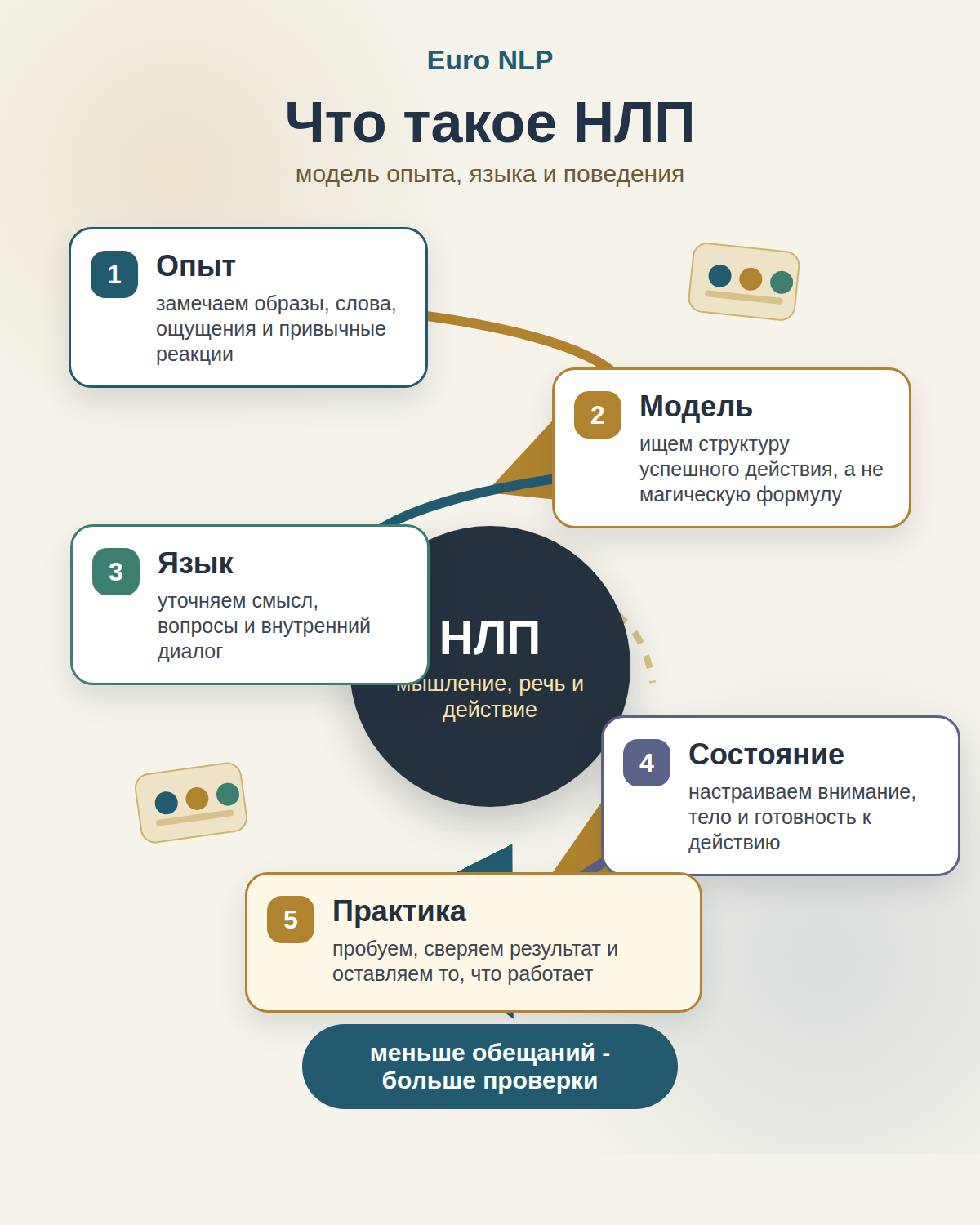
Key Takeaways From This Article
In practical terms, NLP helps break human experience down into understandable elements: language, attention, state, strategy, and action. In good hands, this kind of breakdown helps you learn faster, communicate more precisely, and notice more options where before there seemed to be only one.
Articles alone usually aren’t enough for systematic learning. You need practice, exercises, and feedback. The site has a page for NLP Practitioner, where you can see the training format and decide whether that path is right for you.