06.10.2015
NLP and Phobias: How the Fast Reaction Change Technique Works
 NLP and Phobias: The Idea Behind Working with Fear

NLP and phobias are often discussed through the promise of a fast result. To put it more precisely: NLP has techniques that help change the automatic reaction to a frightening stimulus. A person learns to recall the situation differently, keep distance from the image of fear, and regain a sense of control.
This isn’t about arguing with fear or forcing yourself to be brave. A phobic reaction often triggers faster than a person can think. That’s why the work is built through images, the state of the body, an inner film, and new anchors of safety.
If the fear is connected to trauma, panic attacks, a medical condition, or seriously interferes with life, it’s better not to work through it alone. In such cases, careful work with a specialist is needed. The material below describes the general principle of the NLP technique and does not replace therapy or medical help.
How the NLP Technique for Phobias Works
In the classic NLP technique for working with phobias, three things matter: a resource state, safe distance, and a new way of experiencing the old memory. A similar logic appears in other NLP practices and techniques: first the person gets support, then changes the inner structure of the experience.
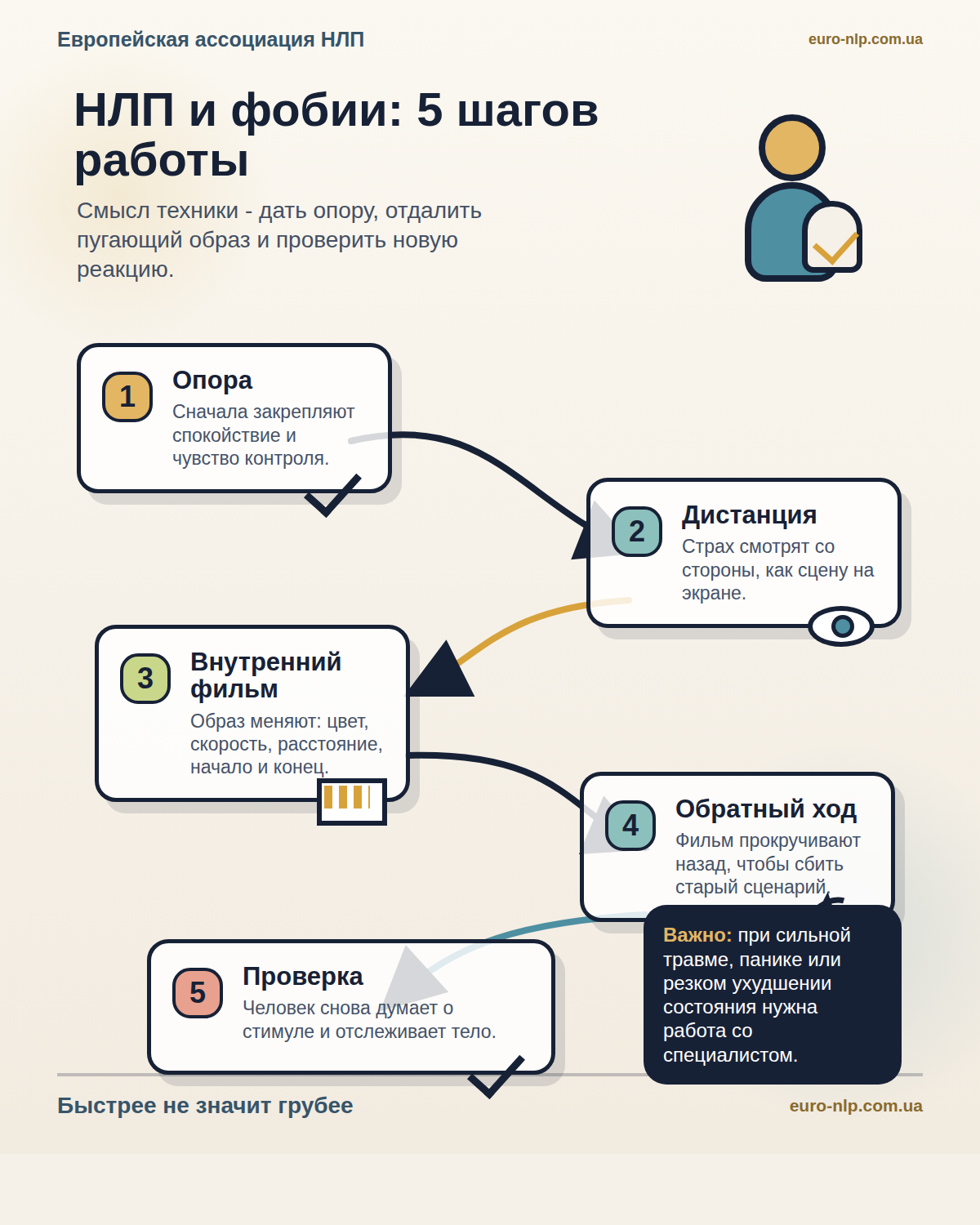
1. First, a Resource Anchor Is Created
Before working with fear, the person is helped to recall a state of calm, strength, or confidence. This state is anchored through a kinesthetic anchor: a touch, a gesture, a body position, or another signal. Such an anchor is needed so the person has inner support rather than a bare collision with fear.
2. Then a Safe Distance Is Added
 Next, the person recalls or imagines the situation not directly, but as if watching a film from the outside. The image of a movie theater is often used: the person sits in the audience and sees themselves on the screen. This detachment reduces the intensity of the reaction and gives more control.
3. Fear Is Viewed Like a Film
The technique uses a sequence of images: the time before the phobia appeared, the event itself, and the state afterward. Sometimes the image is made black-and-white, then the color, speed, and playback direction are changed. The point isn’t beautiful visualization but stopping the brain from triggering the old reaction according to the previous script.
4. The Reaction Is Played in Reverse
One of the most powerful elements of the technique is rewinding. The person, in effect, plays the inner film backward, from the end to the beginning. This helps break the usual chain: stimulus, sharp bodily response, avoidance. After several repetitions, the frightening image is often perceived differently.
5. The New State Is Checked
After the main work, it’s important to check what has changed. The person thinks about the former stimulus again and monitors the body: breathing, tension, the urge to back away, the level of calm. If the reaction has become softer, the new way of behaving is reinforced, and careful steps for future situations are chosen.
Why the Technique Can Work Quickly
A phobia rests on meaning and on the form of the experience: the brightness of the image, the distance to it, the bodily reaction, the inner dialogue. NLP works precisely with this structure. That’s why change sometimes happens quickly: the person isn’t changing the story of the past but the way the brain reproduces it right now.
Here it’s important not to promise a miracle. Some people feel noticeable relief after a single session, while others need a series of meetings and a gentler pace. Much depends on the depth of the fear, the context, the person’s readiness, and how carefully the process is conducted.
When to Be More Careful
Self-guided experiments with strong fears aren’t right for everyone. If the phobia is linked to traumatic experience, panic attacks, obsessive states, or a sharp decline in well-being, it’s better to see a specialist. In working with fears, safety matters more than speed.
To get acquainted with the method, you can start with more neutral topics: understand what NLP is, learn simple exercises, and see how state-change techniques are built. For example, the site has a separate breakdown of the NLP technique for bringing something new into life.
What a Person Gains After the Work
The goal of the work isn’t to erase the memory or make the person reckless. A good result looks calmer: the former stimulus no longer instantly seizes the body — a pause appears, along with choice and more inner freedom. The person can decide where to act more boldly and where ordinary caution is needed.
Training in this format of technique gives separate attention to: how to create a resource, how to guide a person through an image, how to check changes, and how not to push the process. If you want to study this systematically, take a look at the NLP Practitioner program.