03.10.2015
The History of NLP: From Modeling to Modern Practice

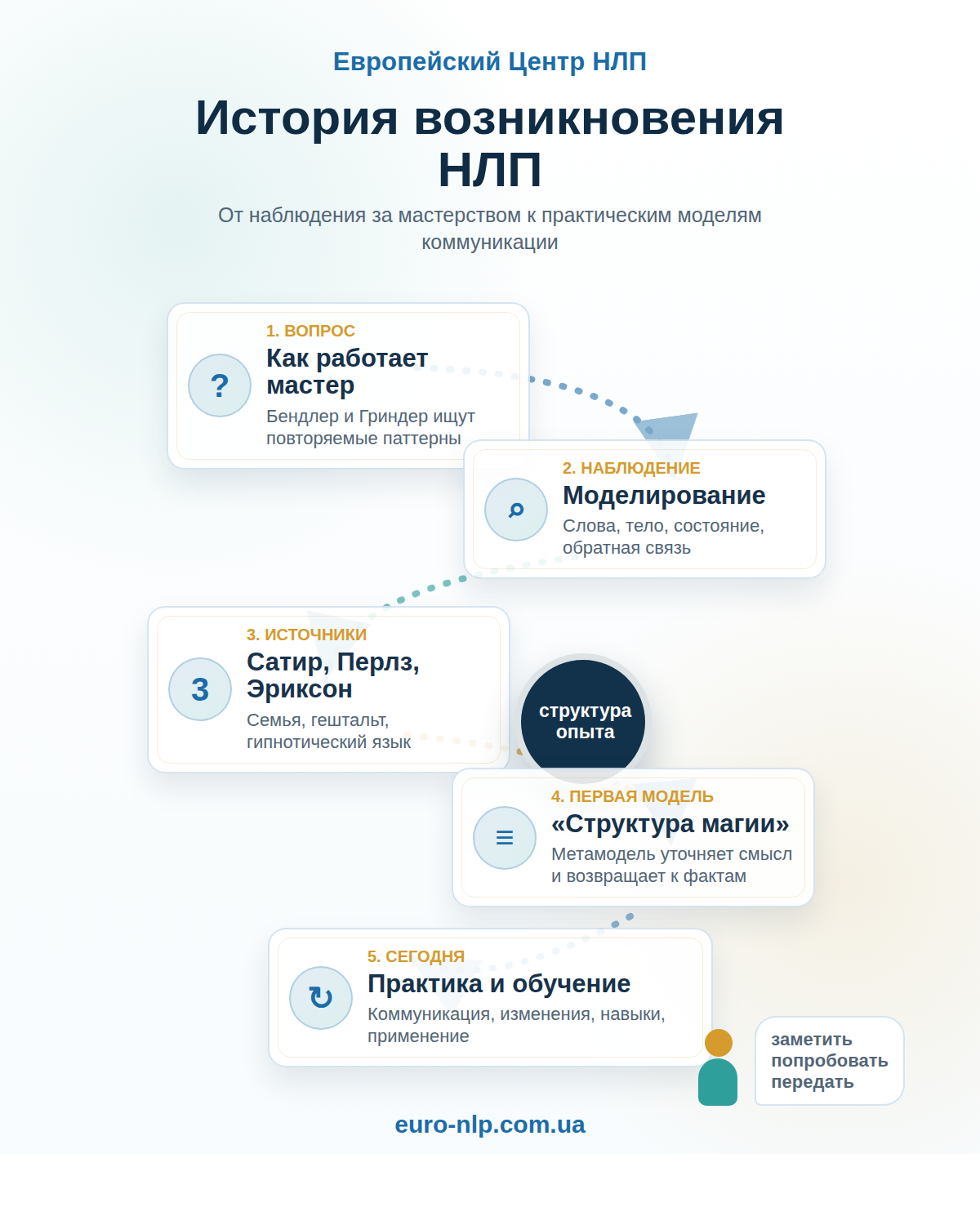
The history of NLP began with a very practical research question: what exactly do people do who manage to help others quickly and precisely. In the late 1960s and early 1970s, Richard Bandler and John Grinder in California began studying the work of highly skilled psychotherapists and searching for repeatable linguistic, behavioral, and cognitive patterns.
This is how neuro-linguistic programming gradually took shape. Its early idea was simple: if a master does something effectively, that skill can be carefully described, broken down into steps, and passed on to others. So NLP grew out of modeling, not out of an armchair attempt to invent a universal psychological system.
How NLP Emerged
The work on NLP is connected to the University of California, Santa Cruz. Bandler was interested in psychotherapy and processing session recordings, Grinder was a linguist, and around them was an intellectual environment discussing systems thinking, communication, anthropology, and cybernetics.
Gregory Bateson played an important role in the early stage. He helped view communication more broadly: as a system of relationships, context, feedback, and influence. This became an important framework for NLP. Specialists examined the therapist’s words, attention to the client’s reactions, pacing, the precision of questions, and the way of guiding a person toward new experience.
Who the Founders of NLP Modeled
At the origins of NLP, three masters are most often named: Virginia Satir, Fritz Perls, and Milton Erickson. Each had their own style, but they were united by one thing — their work produced a noticeable effect that people wanted to understand and describe.
Virginia Satir and Family Therapy
Satir worked with subtlety on family relationships, postures, intonations, roles, and hidden messages. For NLP, her approach became a source of observations about how a person expresses their inner state through body, voice, and speech.
Fritz Perls and the Gestalt Approach
Perls paid a great deal of attention to the present moment, direct experience, and contact with feelings. In NLP, this was reflected in an interest in how a person constructs experience here and now: what they see, hear, feel, and how they change their state.
Milton Erickson and Hypnotic Communication
Erickson worked gently, flexibly, and in a highly individualized way. His language, metaphors, and ability to bypass resistance became a separate direction of modeling. This later influenced the development of Ericksonian hypnosis within the NLP approach.

The First Books and the Meta-Model
The first published results appeared in the book The Structure of Magic. The first volume came out in 1975, the second in 1976. In these works, Bandler and Grinder described how a person’s speech can conceal deletions, generalizations, and distortions of experience.
This is how the Meta-Model appeared — a set of precise questions that helps clarify the meaning of words and bring a person back to concrete experience. In short, the Meta-Model teaches you not to argue with a person but to clarify: who exactly, when, how, by what criteria, what specifically happened. For NLP practice, this became one of the basic tools.
If you need a general explanation of the approach without historical detail, it’s useful to start with the article what NLP is. And Richard Bandler’s view of the very essence of the method is examined separately in the piece “NLP — What Is It?”
Why the History of NLP Matters for Training
The history of NLP’s emergence clearly shows why this approach cannot be reduced to a set of “techniques for every occasion.” At its core lies the modeling of mastery: first observation, then precise description, then training and testing in practice.
That’s why exercises and attentiveness to the structure of experience matter so much in NLP training. A person learns to notice how reactions, beliefs, inner images, speech, and behavior are constructed. From this grow NLP practices and techniques, work with communication, negotiation, learning, habit change, and personal states.
How NLP Continued to Develop
After the first publications, NLP continued to develop. New models, formats of work, training programs, and areas of application emerged. The approach began to be used in psychotherapeutic practice, business communication, negotiation, education, coaching, and personal effectiveness.
It’s important to keep a balance. The history of NLP is rich with strong ideas, but a lot of myths and overly loud promises have accumulated around the method. It’s better to view NLP as a practical discipline of observation, communication, and skill modeling. You can see exactly where it’s applied today in the article on the modern application of NLP.
NLP began as an attempt to understand mastery: to see how highly skilled specialists think, speak, notice reactions, and help a person change their experience.
Brief Summary
The history of NLP’s emergence is a path from observing outstanding therapists to a system of practical models. Bandler, Grinder, Bateson, Satir, Perls, and Erickson influenced different aspects of this approach: language, systems thinking, bodily reactions, work with states, and precision of communication.
That’s exactly why NLP is best learned through practice. History provides context, but the true meaning of the method reveals itself when a person begins to notice the structure of their own experience and try new ways of communicating, thinking, and acting.