NLP training standards aren’t about earning an attractive certificate. They show exactly what a person is learning, how much practice they get, and how closely the program connects to modern communication, coaching, negotiation, and personal change.
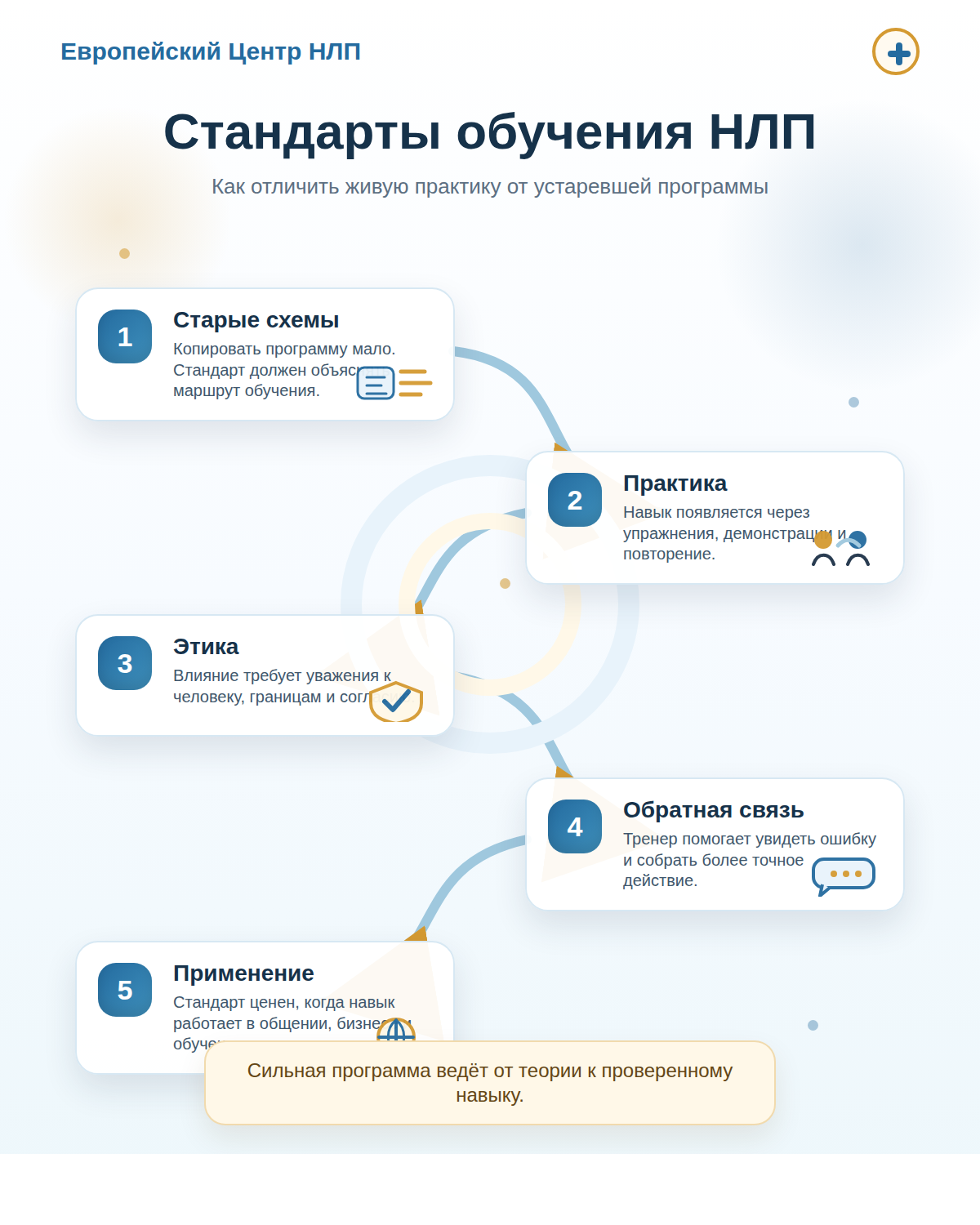
The training market still has plenty of programs that copy the old templates of the post-Soviet school. Some of those templates were useful in their time, but the world of learning has moved on. European and American NLP training standards emphasize practice, ethics, feedback, and the ability to apply a skill in real situations — not just recite theory.
What sets modern NLP training standards apart
A good NLP program is built around skill. The participant hears an explanation of a technique, tries it out, gets feedback, notices their own mistakes, and gradually builds a reliable way of acting. That’s the whole point of a standard — it keeps the quality of training from being left to chance.
More practice and live feedback
In modern programs, exercises, demonstrations, breakdowns, and work in pairs or small groups matter most. Theory still has a place, but it works as a map. Skill appears once a person starts hearing what the other side is really saying, noticing nonverbal signals, asking precise questions, and checking the result in practice.
Ethics instead of blunt pressure
NLP is often mistakenly linked to manipulation. That’s exactly why a training standard needs to set a clear ethical frame on its own: respect for the person, clear consent, responsibility for one’s influence, and an understanding of the method’s boundaries. We cover this topic in more depth in the article “Is NLP Manipulation? The Truth and the Myths About NLP”.
European vs. American approach: what’s the difference
The American tradition of NLP grew out of modeling outstanding practitioners. Its strength is searching for strategies that work, running experiments, and moving quickly from observation to technique. European training culture more often adds structure, attention to context, communication ethics, and a specialist’s long-term development on top of that.
For a training center, what matters isn’t a formal tie to geography but the quality of the learning logic itself. A program should answer a few simple questions: what will the person learn, where will they apply it, how will the trainer check that the skill has been mastered, and what will count as a real result.
How we look at program quality
For the European NLP Center, a standard is a practical reference point. It helps us build training so that the participant understands the route: from basic concepts and techniques to independent application in communication, learning, business, consulting, or personal work.
That’s why applied directions and the modeling of successful strategies matter alongside basic courses. For example, the page Advanced NLP: Results of NLP Modeling brings together topics that show how NLP develops beyond the beginner level.
What to look for when choosing a program
- does the program have a clear structure moving from simple to complex;
- does it include enough practice, demonstrations, and feedback;
- does the trainer separate technique, ethics, and personal responsibility;
- is it clear where the participant will be able to apply the skills gained;
- is there a connection to further training and professional growth.
If you’re still choosing a training format, start with the general NLP training section or check out the NLP Practitioner Training in Kyiv program. It makes it easier to see how standards turn into an actual learning path.