Advanced NLP modeling helps you look at successful strategies not as a collection of nice ideas, but as a repeatable experience. The focus is on how people think, make decisions, build communication, and carry working models over into business, learning, and personal development.
For the European NLP Center, this topic connects to a practical question: which approaches from Western business and educational culture can be adopted without losing your own history, language, and character. Not copying the form for its own sake, but understanding what actually produces results.
What Advanced NLP offers
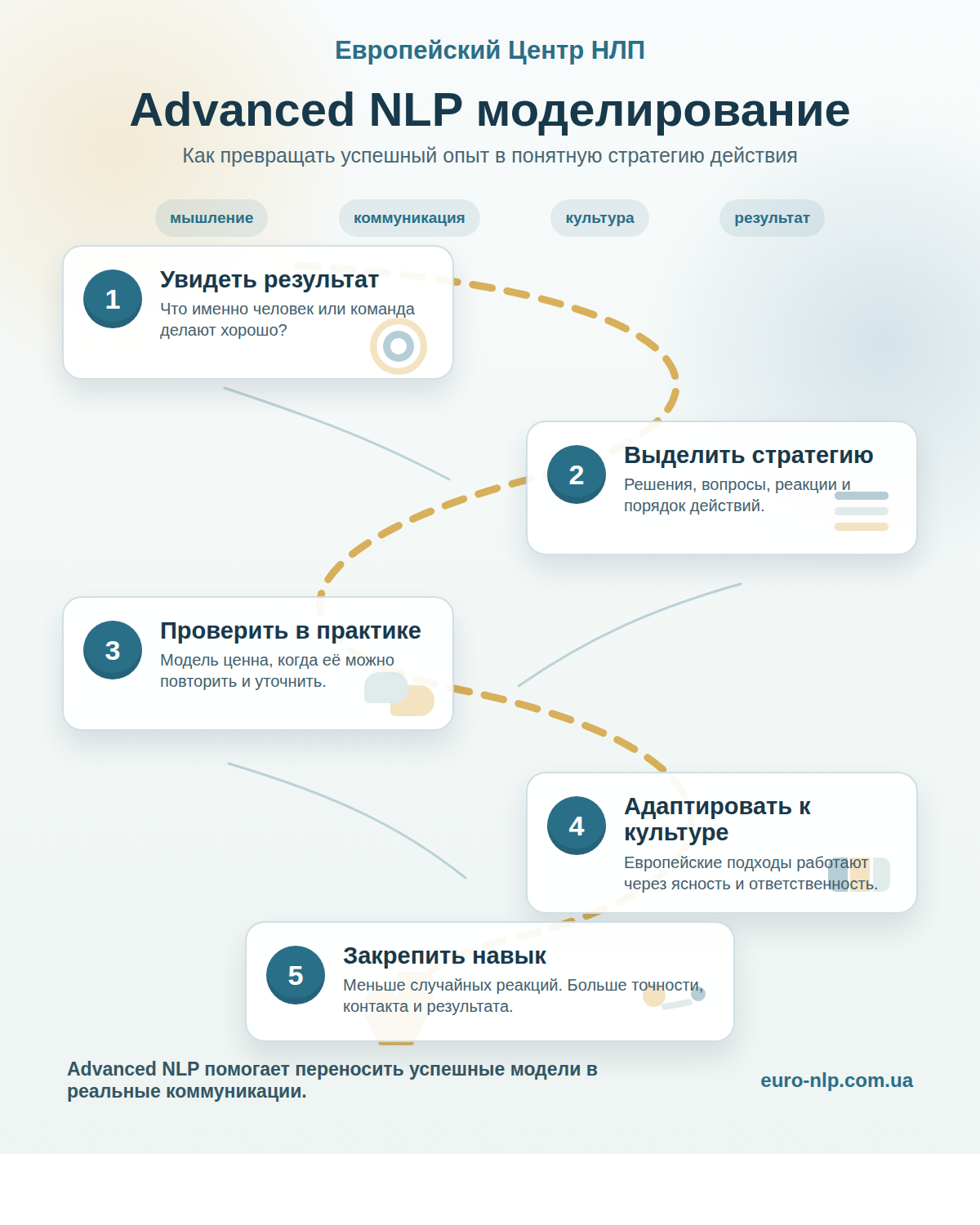
Advanced NLP works with a more subtle layer of skill. What matters here is patterns of thinking, habitual reactions, how you ask questions, how you negotiate, how you learn from feedback, and noticing what actually lets one person or team achieve a stable result.
Results of NLP modeling
The results of NLP modeling become useful once they can be applied in a real situation — in negotiation, team management, training, public communication, or personal effectiveness. A good model doesn’t promise instant miracles. It shows a sequence of actions you can test, practice, and adapt to yourself.
The European context
Business culture and attitudes toward responsibility differ noticeably from country to country. If your work involves Europe, the UK, or America, it helps to understand those differences in advance. The European approach more often calls for clear agreements, respect for boundaries, precision in communication, and a willingness to answer for the result.
At the same time, this kind of development doesn’t require giving up your own identity. On the contrary, a strong professional stance emerges precisely where a person keeps their own foundation while adopting new working strategies. This view is explored further on the page about European communication culture and in the material on NLP training standards.
Where this applies
Advanced NLP is especially useful for those who already know the basic techniques and want to understand more deeply how effective strategies are built. That might be a manager, a trainer, a consultant, an HR specialist, an entrepreneur, or anyone who works with people and regularly deals with influence, motivation, conflict, and choice.
If you’re more interested in applied programs, you can start with an overview of NLP training or a separate piece on NLP training for business.
The main point
Advanced NLP and modeling are valuable when they help a person act more precisely — fewer random reactions, more clarity, better contact with people, and closer attention to the outcome. That’s exactly why working with behavioral models becomes part of professional development, not a separate theory for theory’s sake.