30.05.2026
Interpersonal Skills in NLP: How to Train Live Communication
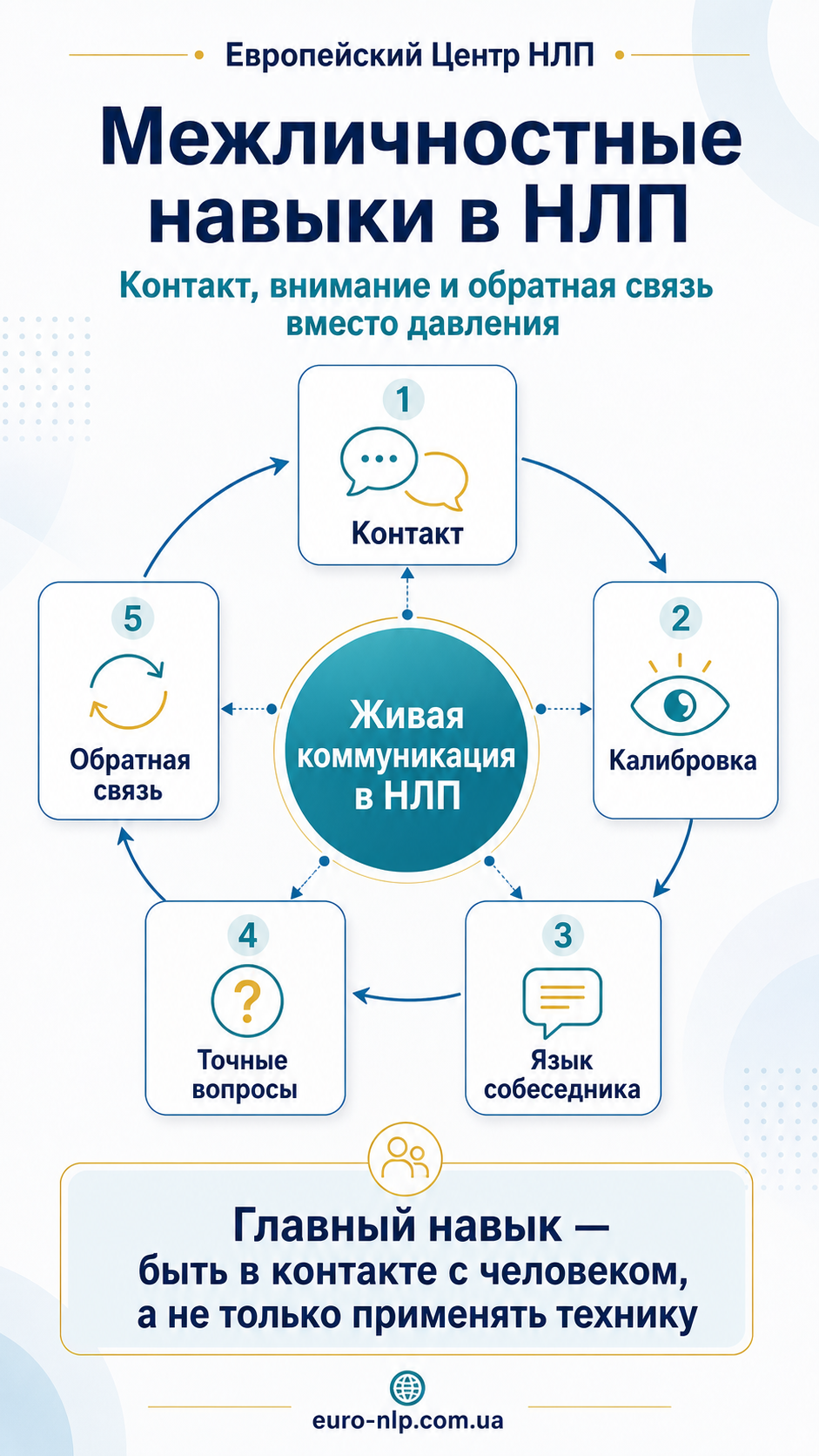
Interpersonal skills in NLP have to do with how a person builds rapport, listens, asks questions, notices the other person’s reaction, and adjusts their way of communicating based on feedback. This isn’t about pressure. Good communication rests on attention, precision, and respect for boundaries.
These skills are needed in negotiations, training, sales, management, consulting, and everyday difficult conversations. You can learn them in a course, or train them in a targeted way in an individual format.
What Interpersonal Skills in NLP Include
NLP pays a lot of attention to how people perceive the world and convey meaning. One person speaks through images, another through sensations, a third through structure and criteria. If you don’t notice this, a conversation quickly turns formal.
An interpersonal skill starts with calibration: the ability to see changes in voice, pauses, facial expression, gestures, and speech tempo. This helps you understand where the other person engaged, where they tensed up, and where they lost interest.
Rapport Matters More Than a Rehearsed Technique
A technique on its own doesn’t save a conversation. If a person speaks mechanically, the other side feels it. That’s why rapport comes first: a calm frame, attention, a clear goal, and a readiness to check how you’re being understood.
The ethical side matters here in principle. NLP works better in communication when a person doesn’t push, but helps the dialogue become more precise. This is nicely complemented by the article European culture of communication.
Where This Is Especially Useful
In negotiations, interpersonal skills help you hear the other side’s criteria, ask precise questions, and hold on to the goal of the conversation without unnecessary tension. There’s a dedicated program for this: NLP influence in negotiations and sales.
In training and consulting, these skills help you quickly grasp how a person thinks, where they lose clarity, and what example they need. In personal relationships – less guessing, more checking meaning through words.
How to Train Communication
You can start with a simple exercise. In an ordinary conversation, pick one parameter to observe: speech tempo, pauses, breathing, gestures, or key words. Don’t try to track everything at once. The task is to develop precision of attention.
After the conversation, ask yourself: where did the rapport strengthen, where did it weaken, which words helped, and which created tension. This is how the skill of seeing a conversation as a living process, rather than an exchange of lines, gradually develops.
Connection to Individual Coaching
If you have a specific communication task, the individual format gives you a fast route to practice. You can work through negotiations, a difficult conversation, a presentation, work with a client, or a recurring conflict scenario.
The page individual NLP coaching in Kyiv was created for this kind of work. It describes how a session is structured and how it differs from the group course NLP training.