02.06.2026
Classic NLP Techniques in 2026: What Has Actually Changed
Articles about “new NLP techniques for 2026” often list familiar things: affirmations, visualization, anchoring, modeling, reframing, the language meta-model, sleight of mouth, priming, and submodality work. That’s not a coincidence. Most of modern NLP grew out of classic methods that picked up new language and a new context.
In 2026, it’s not the foundation that’s changing but the way it’s applied. AI tools, body-based practices, neuro-semantics, generative coaching, digital hygiene, and a more attentive approach to a person’s state are all entering the work. Old techniques start to sound contemporary when they’re connected to real problems: information overload, phone dependency, an anxious inner dialogue, difficulty making choices, fatigue from cookie-cutter advice.
Below is an extended breakdown of ten techniques. This isn’t a ranking and it isn’t a promise of quick miracles. It’s a map: where each method came from, what remains classic in it, and what meaning it takes on in 2025-2026.

Why “New NLP Techniques” Often Turn Out to Be Classics
From the very start, NLP looked at experience as a structure: what a person sees inside, what they tell themselves, where in the body a reaction arises, which words they choose, which steps they repeat in their behavior. That’s why the basic techniques don’t go out of date as quickly as the labels around them.
Today a practitioner can analyze text faster with AI, notice bodily reactions more precisely, account for the influence of smartphones and social media, and use coaching models of change. But the person and their experience still remain at the center.
The simple criterion is this: a technique is useful if it helps someone notice an internal process and choose a more suitable response. If a method turns into a magic formula, it’s worth re-examining.
1. Affirmation: From Generic Phrases to a Precise Internal Statement
The essence. An affirmation is the repetition of a positive statement that supports a new belief, state, or direction of attention.
The classic foundation. In NLP, this kind of work is tied to language, submodalities, and internal dialogue. It matters how the phrase sounds when you say it and notice it inside: convincing, foreign, forced, calm, alive.
The 2026 reframe. An affirmation becomes stronger once it stops being a template pulled from the internet. AI can help break down a client’s speech: which words they choose, where they devalue themselves, how they construct limitations, which phrasings sound natural to them. After that, the statement becomes personal rather than decorative.
Practical nuance. A weak affirmation argues with a person’s experience. A strong statement offers the next possible step. Instead of “I’m always confident,” it works better to say: “I can notice tension, exhale, and choose a calmer response.”
2. Visualization: An Image That Engages the Body
The essence. Visualization uses internal images, sounds, and sensations so a person can imagine a desired state, action, or outcome.
The classic foundation. This is a foundational NLP technique dating back to the 1970s. It relies on VAK — the visual, auditory, and kinesthetic systems. A person sees an internal picture and refines its size, brightness, distance, movement, sound, and bodily response.
The 2026 reframe. In contemporary approaches, visualization is increasingly combined with embodied NLP and somatic practices. The image gets checked against the body: does breathing, posture, muscle tone, or the sense of space change? If the body stays tense, the picture may look nice but remain weak.
Practical nuance. Good visualization doesn’t replace action. It prepares attention and the body for action. A useful question for practice: what small bodily signal will show that the new state has become more accessible?
3. Anchoring: From a Gesture to a State of the Nervous System
The essence. Anchoring creates a link between a stimulus and an emotional state. The stimulus can be a gesture, a touch, a word, an image, a sound, a breathing rhythm, or a posture.
The classic foundation. NLP has used anchoring since the 1970s. A person first enters the desired state, then, at the peak moment, links it to a specific stimulus. Later, the stimulus helps them return to that state more quickly.
The 2026 reframe. In the new context, anchoring becomes more body-based. A practitioner watches for gesture, breathing, torso position, micro-movements, foot stability, facial relaxation, and speech tempo. The state gets anchored through the nervous system rather than through a single mechanical “hook.”
Practical nuance. An anchor works better when it’s simple, unobtrusive, and tied to a real situation. For example, a calm exhale before an important conversation is often more useful than an elaborate ritual that’s hard to repeat in everyday life.
4. Modeling: NLP Classics Plus Pattern Analysis
The essence. Modeling studies a person’s successful strategy and translates it into steps that can be understood, tested, and adapted.
The classic foundation. NLP grew out of modeling. Richard Bandler and John Grinder studied the work of Fritz Perls, Virginia Satir, and Milton Erickson to understand which linguistic, behavioral, and perceptual patterns produced results.
The 2026 reframe. AI makes it possible to analyze large bodies of text faster: interviews, talks, correspondence, negotiation transcripts, public speeches. It can highlight recurring speech patterns, values, points of focus, and argument structure.
Practical nuance. AI doesn’t replace live modeling. It provides hypotheses. Real verification begins where a person tries the strategy in action and notices what fits their character, body, and context.
5. Framing: Managing the Frame of Perception
The essence. Framing changes the frame through which a person perceives a situation. The same fact can look like a failure, a training exercise, a signal, a transitional stage, or feedback.
The classic foundation. In NLP, framing is tied to reframing and working with context. The fact stays the same, but the meaning inside the psyche changes.
The 2026 reframe. Here the connection to Michael Hall’s Meta-States Model and neuro-semantics is easy to see. A person works with the situation and with their attitude toward their own attitude. For example, one can explore fear, shame about the fear, anger at oneself for feeling insecure, or anxiety about the anxiety itself.
Practical nuance. A frame shift shouldn’t invalidate the pain. Healthy framing doesn’t force someone to feel happy about a problem. It adds room for choice.
6. Reframing: New Meaning for an Old Reaction
The essence. Reframing helps see a problem in a different context or find a different meaning for a reaction. In NLP, people often distinguish context reframing, content reframing, intention reframing, presupposition reframing, and time-based reframing.
The classic foundation. Reframing is tied to the early work of Bandler and Grinder, including “The Structure of Magic.” It helps explore which generalizations, distortions, and deletions keep an old problem in place.
The 2026 reframe. In contemporary coaching approaches, reframing is increasingly becoming systemic. Within Generative Coaching and Generative Change, associated with Stephen Gilligan and Robert Dilts, attention shifts toward state, the relational field, the image of the future, and the resources a person can create.
Practical nuance. Good reframing doesn’t argue with the person. It adds an option. The old meaning can remain understandable, but it no longer has to be the only one.
7. The Language Meta-Model: Questions That Restore Precision
The essence. The language meta-model helps identify generalizations, distortions, and deletions in speech. It brings a person back from vague phrasing to concrete experience.
The classic foundation. The meta-model was described in Bandler and Grinder’s “The Structure of Magic” in 1975. Its questions help clarify: who exactly, when, based on what evidence, what specifically happened, and which part of the experience got left out of the story.
The 2026 reframe. AI tools can automatically flag language patterns: “always,” “never,” “no one,” “I have to,” “I won’t be able to,” “it’s impossible.” This speeds up the initial analysis of a text, a journal entry, a client’s request, or correspondence.
Practical nuance. The meta-model requires tact. The questions can help, or they can sound like an interrogation. In 2026, precision is valued alongside respect for the person’s state.
8. Sleight of Mouth: Beliefs That Can Be Unpacked
The essence. Sleight of mouth patterns are speech patterns for working with beliefs. They help redefine meaning, explore consequences, break down a statement, look for analogies, and view things from another perspective.
The classic foundation. These patterns are tied to the work of Robert Dilts and the development of NLP in the 1980s. The underlying idea is that a belief rests on facts and on the connection between words, experience, and conclusions.
The 2026 reframe. The contemporary shift adds bodily experience. A person hears a new phrase and notices how it changes their breathing, tension, gaze, posture, and impulse to act. If the body doesn’t believe the words, the pattern remains an intellectual game.
Practical nuance. Sleight of mouth patterns are useful wherever a rigid belief is present. But they should expand choice, not break resistance by force.
9. Priming: Setting the Context Before Action
The essence. Priming is the influence of prior information on perception, decisions, and behavior. In NLP, it can be understood as setting up attention before a task.
The classic foundation. NLP practice has long used preliminary frames, verbal cues, images, stories, and states that prepare a person for a particular kind of response.
The 2026 reframe. The contemporary context adds knowledge about cognitive biases, attention, digital overload, and information consumption habits. Priming becomes more precise: what a person sees before a task, what words they read, what state they enter a conversation in, which notifications disrupt their attention.
Practical nuance. Ethical priming helps a person get into the right state rather than manipulating them covertly. For learning and self-development, simple forms work well: preparing your workspace, choosing a setup phrase, removing extra stimuli, and defining the state you want for a task in advance.
10. “Drying Out”: Submodalities in the Age of Digital Attachment
The essence. “Drying out,” a submodality technique, weakens emotional dependency on a person, an image, or a situation.
The classic foundation. In the Russian-language NLP tradition, this technique is tied to the Institute of Modern NLP and Mikhail Pelekhaty. It’s built on working with an internal image: distance, brightness, size, movement, sound, bodily response, and emotional intensity.
The 2026 reframe. Today this logic is increasingly applied to digital dependencies: social media, messaging apps, compulsive phone-checking, emotional attachment to correspondence, reactions to online statuses and notifications. The object of the work becomes a person, a memory, a chat thread, or a digital hook.
Practical nuance. It’s important not to confuse “drying out” with suppressing feelings. The technique is useful when you need to regain distance and the ability to choose, not to erase a living emotional history.
Comparison Table of NLP Techniques in 2026
| Technique | Classic foundation | 2026 reframe | Integration |
|---|---|---|---|
| Affirmation | Internal dialogue and submodalities | Personal phrasing based on language patterns | NLP + AI |
| Visualization | VAK and work with internal images | Checking the image through breath, posture, and bodily response | NLP + somatic |
| Anchoring | Link between stimulus and state | Somatic anchoring through the nervous system | NLP + body |
| Modeling | Analysis of successful people’s strategies | AI analysis of speech, interviews, and behavioral patterns | NLP + AI |
| Framing | Changing the frame of perception | Working with states about states | NLP + Meta-States |
| Reframing | New meaning for a reaction or situation | Systemic, generative approach | NLP + Generative Change |
| Meta-model | Questions targeting generalizations, distortions, and deletions | Automatic highlighting of language traps | NLP + AI analysis |
| Sleight of mouth | Speech patterns for beliefs | Checking new meaning through the body | NLP + embodied practice |
| Priming | Pre-setting attention | Accounting for cognitive biases and digital overload | NLP + neuroscience |
| “Drying out” | Submodality work with emotional attachment | Applied to social media, correspondence, and digital triggers | NLP + digital wellness |
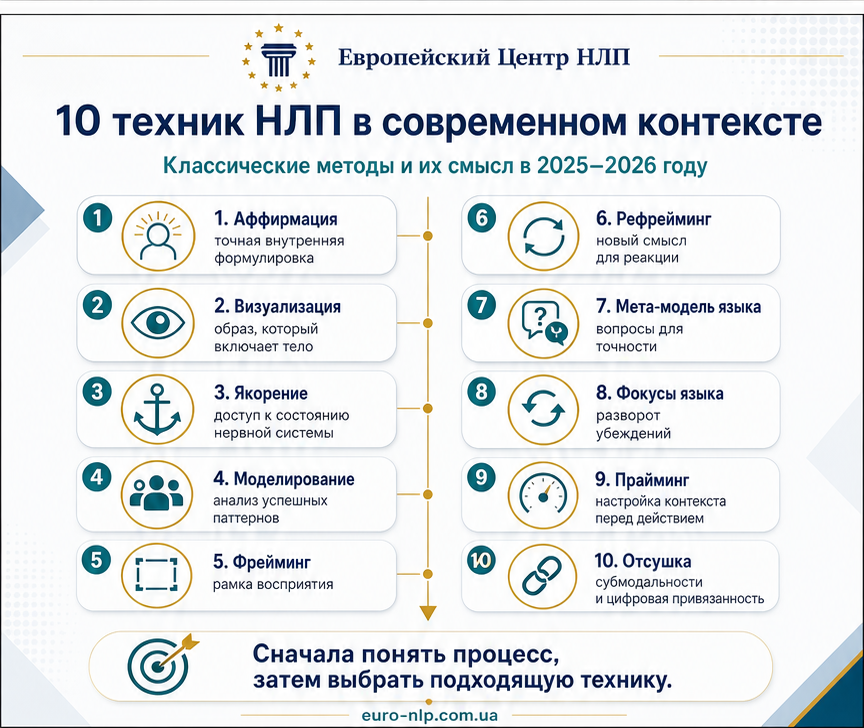
The Main Takeaway
Classic NLP techniques aren’t disappearing in 2026 or turning into museum pieces. They’re being reframed. Affirmations are becoming more precise, visualization more embodied, anchoring closer to the nervous system, modeling richer thanks to data analysis, the meta-model faster thanks to AI, and submodality techniques are gaining a new field of application in the digital environment.
The core principle stays the same: a technique works when a person notices the structure of their own experience more clearly and gains more choice. Everything else is packaging, tools, and the language of the times.
Related Materials
To get a better grasp of the fundamentals, start with the article on what NLP is and how it works. For practical context, see NLP practices and techniques, personal mastery in NLP, and Is NLP Manipulation? The Truth and Myths About NLP.