30.05.2026
Personal Mastery in NLP: Where Working on Yourself Begins
Personal mastery in NLP is the ability to notice how your own reactions are built and gradually change them through practice. This isn’t about nice-sounding motivation – it’s about concrete things: state, attention, inner dialogue, images, goals, and habitual behavior strategies.
This is often where individual coaching begins. Until a person sees how they themselves create their state and their decisions, techniques remain theory. Once observation appears, choice appears.
What NLP Calls Personal Mastery
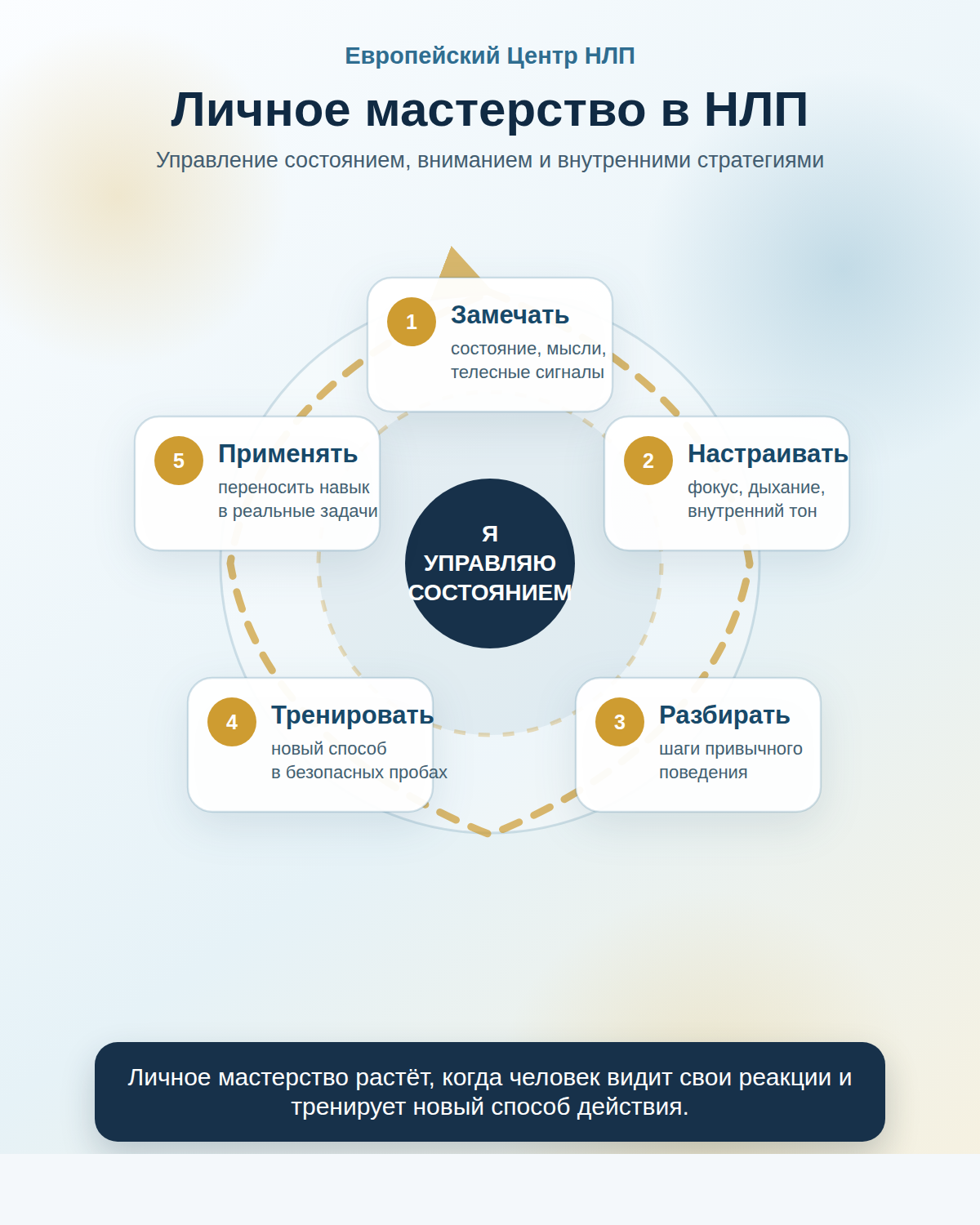
In practical terms, personal mastery is the ability to manage yourself in situations where automatic reactions used to take over. A person can notice tension, shift focus, recall a resourceful experience, choose a more precise reaction, and hold on to a goal.
If you need the basics, it’s worth starting with the article what NLP is. It explains why NLP looks at experience as a structure: images, sounds, sensations, words, habitual steps, and reactions.
Why Understanding Alone Isn’t Enough
Many people understand perfectly well what they need to do, yet in a real situation they act out the old script again. That’s normal. A skill doesn’t live in an explanation – it lives in repetition. That’s why personal mastery is trained through small practical steps.
For example, a person learns to notice the moment they lose composure. Then they try a different way of breathing, change the inner picture, clarify the purpose of the conversation, or recall a state in which they already handled a similar task.
Which Skills Develop
Personal mastery usually involves several directions. The first is self-observation – without it, it’s hard to know what exactly to change. The second is state management. The third is working with goals and inner criteria. The fourth is the ability to carry successful strategies from one area of life into another.
Related tools are described in the overview of NLP practices and techniques. But in individual work they’re chosen carefully – not to fit an abstract scheme, but to fit the person and their situation.
How This Connects to Individual Coaching
In an individual session, you can take one recurring situation and break it down into steps. What does the person see? What do they tell themselves? Where in the body does the reaction show up? What result do they want? What new strategy is worth practicing?
This format is useful when you need precise feedback and an unhurried pace. You can read more about this format on the page individual NLP coaching in Kyiv.
Where to Start on Your Own
Choose one small situation where you’d like to be more composed. Don’t pick the most painful case. It’s better to start with an ordinary conversation, a work task, or a familiar bout of inner tension.
After the situation, write down three things: what you noticed in yourself, what worked better than usual, and what’s worth practicing next time. A journal like this quickly shows that personal mastery is built out of concrete observations, not general promises.
If you’d like to walk this path with a coach, take a look at the format of individual NLP coaching or the general course NLP Practitioner in Kyiv.