14.09.2017
How People Come to NLP: A Story from the NLP Practitioner Course

How do people come to NLP? Sometimes out of curiosity. Sometimes after a book, a conversation, or someone else’s result. And sometimes a person arrives almost with an accusation: “What did they do to me, and how do I stop it now?”
This story is exactly about that. It has fear of NLP, suspicion of manipulation, and an unexpected twist: a man wanted to figure out someone else’s influence on him, and ended up noticing his own life instead.
Why NLP Often Scares People
There are plenty of old myths around NLP. Some talk about “brainwashing,” some about hidden techniques of influence, some picture a set of tools for pressuring people. This image is persistent because the topic of communication is inherently sensitive: if a person knows how to listen more precisely, ask questions, and notice reactions, it can feel like they’ve gained some secret lever.
We covered this topic separately in the article “Is NLP Manipulation? The Truth and Lies About NLP”. Here, instead, is a real story about how fear of NLP can lead a person to training.
A Story from a Corporate Party
A middle-aged man once came to us for the NLP Practitioner course. Money, success, and luck didn’t particularly interest him. He had worked in the same position for many years, collected all the usual accolades, bonuses, a private office, and annual family vacations at a sanatorium.
At home things also looked calm: two grown children, a devoted wife, a familiar routine. But one day, at a corporate party, something strange happened.
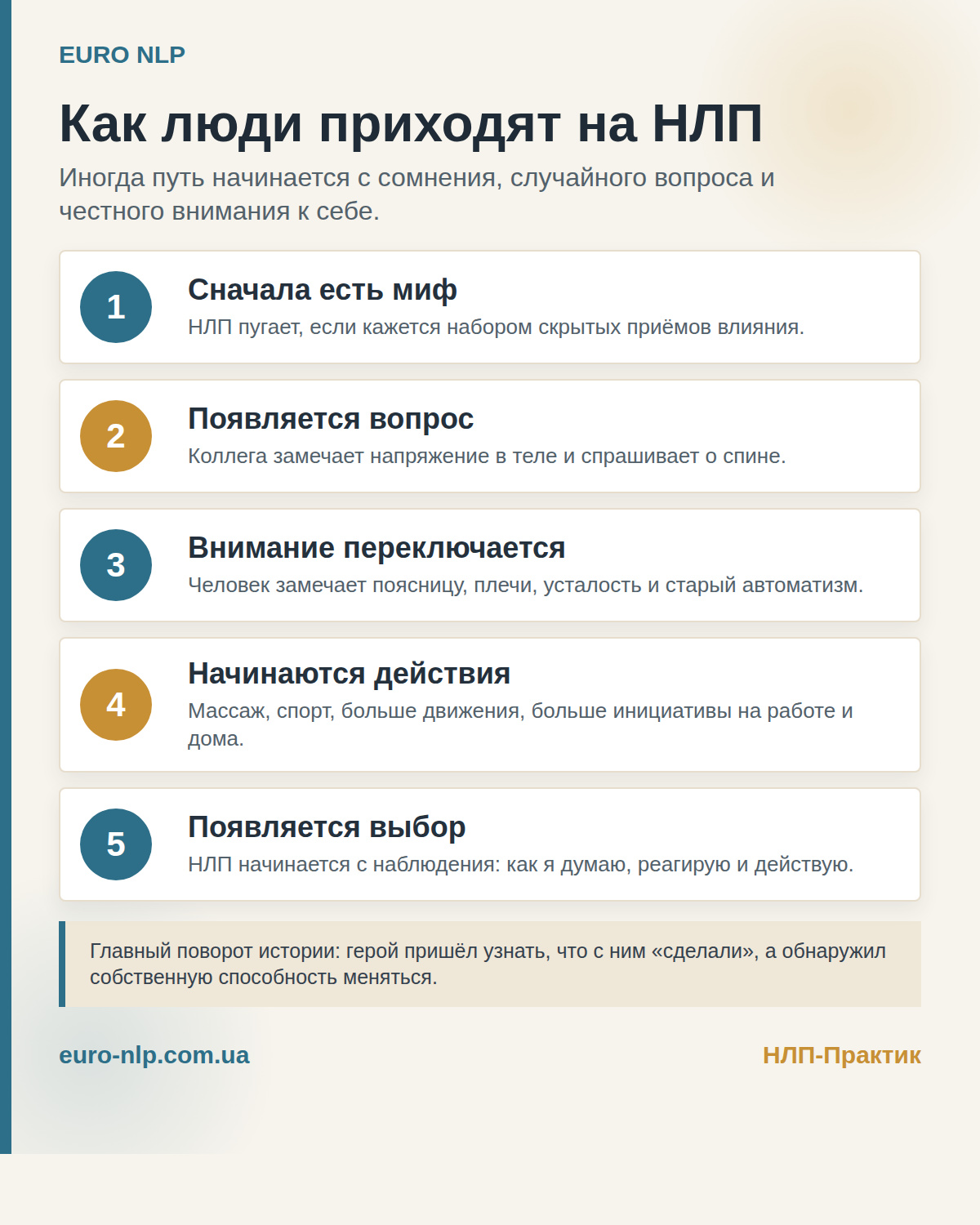
Our hero was sitting at a table with his boss, discussing work matters – focused, responsible, sharp, as always. A colleague walked up, congratulated the management on the occasion, and then suddenly asked our hero how his back was doing.
He was surprised. He didn’t think he had any back problems. The colleague shrugged and explained that his NLP course had taught him to calibrate people: you can tell from someone’s body where they’re carrying tension, fatigue, or habitual strain. “Well, if everything’s fine, then everything’s fine,” he said, and walked off.
What Happened Next
After that conversation, our hero suddenly noticed: his lower back really did ache, his shoulders had rounded forward, his chest seemed caved in. A textbook picture of a workaholic with an enormous sense of responsibility. What used to be background noise had become impossible to ignore.
He got a course of massage, started exercising, and got hooked. At work he began showing initiative that, by his own account, he hadn’t managed in about ten years. At home, too, an energy returned that he’d long assumed was gone for good.
And it was with that question that he came to our training: what had his colleague done to him, and how could he “fix” it?
What Was Really Going On
Strip away the drama and the story becomes fairly simple. The colleague didn’t “install” anything and didn’t force anything. He asked a precise question that landed on tension that already existed. Our hero started noticing his body’s signals, and then took a few ordinary, down-to-earth steps: massage, exercise, more movement, more initiative.
In that sense, NLP often doesn’t start with flashy techniques – it starts with attention. A person notices how they think, speak, react, move, and make decisions. And from there, choice appears.
How People Really Come to NLP
Everyone’s path is different, but there’s usually one thing in common: a person starts feeling cramped inside their old autopilot. They want to understand themselves better, communicate more precisely, react more calmly, act more confidently, or figure out why the same scenarios keep repeating.
Some come for NLP practices and techniques. Some come for communication skills. Some start out arguing with the very idea of NLP, and then discover that it’s more useful to test the tools in practice than to argue with a label.
If you’d like to start with a basic understanding, you can read the material “What Is NLP, Really?”. As for this story, let it stay as a reminder: sometimes the first step toward change looks like a random question at a party table.