03.11.2015
NLP Training for Business: When It’s Actually Useful
 NLP training for business is valuable where a company needs not abstract knowledge, but more precise communication, clear success criteria, and skills employees actually apply in real work.
In business, NLP is most often seen as a practical toolkit for negotiation, sales, training, attention management, and handling customer objections. A good training program on this topic shouldn’t be limited to a lecture. Its job is to help people notice their habitual communication patterns and try new ways of acting.
When Businesses Should Use NLP Technologies
When Efficiency and a Measurable Result Matter
NLP is more results-oriented than many training approaches. And this isn’t about a nice statement at the end of a training session, but about a concrete change in behavior: how a person asks questions, runs a meeting, listens to a client, negotiates, and picks up on feedback.
This is convenient for business: you can agree in advance on the signs that will show the training worked. For example, a manager clarifies a client’s need faster, a leader sets tasks more precisely, negotiators maintain rapport better in a difficult conversation.
When a Skill Needs to Stick After the Course
Corporate training has a common problem: people listen to interesting material, take notes, and a week later slide back into old habits. NLP training is valuable precisely because of its practice. Participants try out a skill repeatedly, get feedback, and gradually build in a new way of acting.
That’s why NLP suits topics where understanding alone isn’t enough. Sales, negotiations, presentations, conflict resolution, mentoring, HR interviews — all of this requires drilling and hands-on practice.
Where NLP Is Especially Applicable in Business
 Negotiation, Sales, and Influence

In negotiation, what matters isn’t pressure but understanding the structure of communication: what a person values, how they make decisions, what they avoid, which words help them state their position more precisely. That’s why commercial teams benefit from a dedicated training on NLP influence in negotiation and sales.
HR, Recruitment, and Employee Development
In HR, NLP helps you work more attentively with motivation, speech patterns, and decision criteria. For example, the topic of NLP metaprograms in HR is useful when you need to better understand how a person perceives tasks, risks, rules, and opportunities.
Corporate Training and Skill Development
If employees have already been through many similar trainings, they often get bored of the same recycled frameworks. NLP can offer a fresh, practical angle: more attention to language, states, perception, and modeling successful behavior. For those who want a broader look at the tools, there’s an overview of NLP practices and techniques.
How to Tell Your Company Needs the NLP Format Specifically
- You need live communication skills instead of standard employee briefings.
- There’s demand for negotiation, sales, influence, presentations, or feedback skills.
- It matters that people learn to notice the other person’s reaction and flexibly change strategy.
- The team is tired of generic trainings and ready to work through exercises.
- Leaders need more precise tools for setting tasks and communicating.
Foundational training is best built up step by step. If someone needs not a one-off corporate module but a systematic grasp of the approach, it’s worth looking at the NLP Practitioner program. It provides the foundation for applying NLP further in work, learning, and personal communication.
Bottom Line
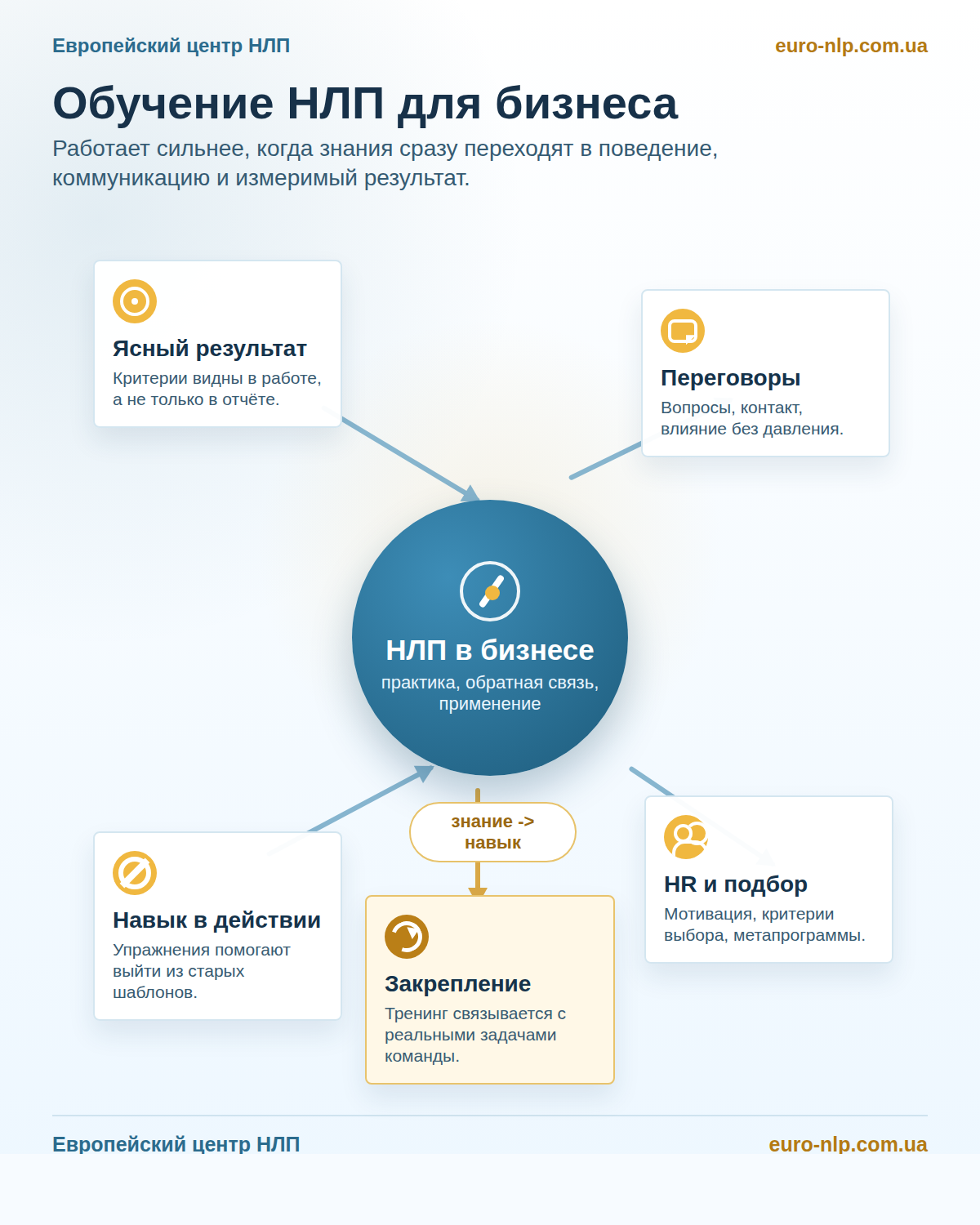
NLP-based training in business makes sense when a company wants to develop specific behavioral skills: communicating more precisely, understanding clients better, negotiating with more confidence, and turning knowledge into action faster. The strongest effect appears when the training is directly tied to participants’ actual work situations.
Author: Kateryna Haiduchenko, NLP Trainer, Kyiv