13.10.2015
NLP Metaprograms in HR: How They Help You Hire the Right People
 NLP metaprograms in HR help you look deeper than the usual list of competencies. In an interview, a person can demonstrate a skill, knowledge, or a polished answer. But metaprograms speak to something else: how they typically think, make decisions, respond to tasks, and choose a way of acting.
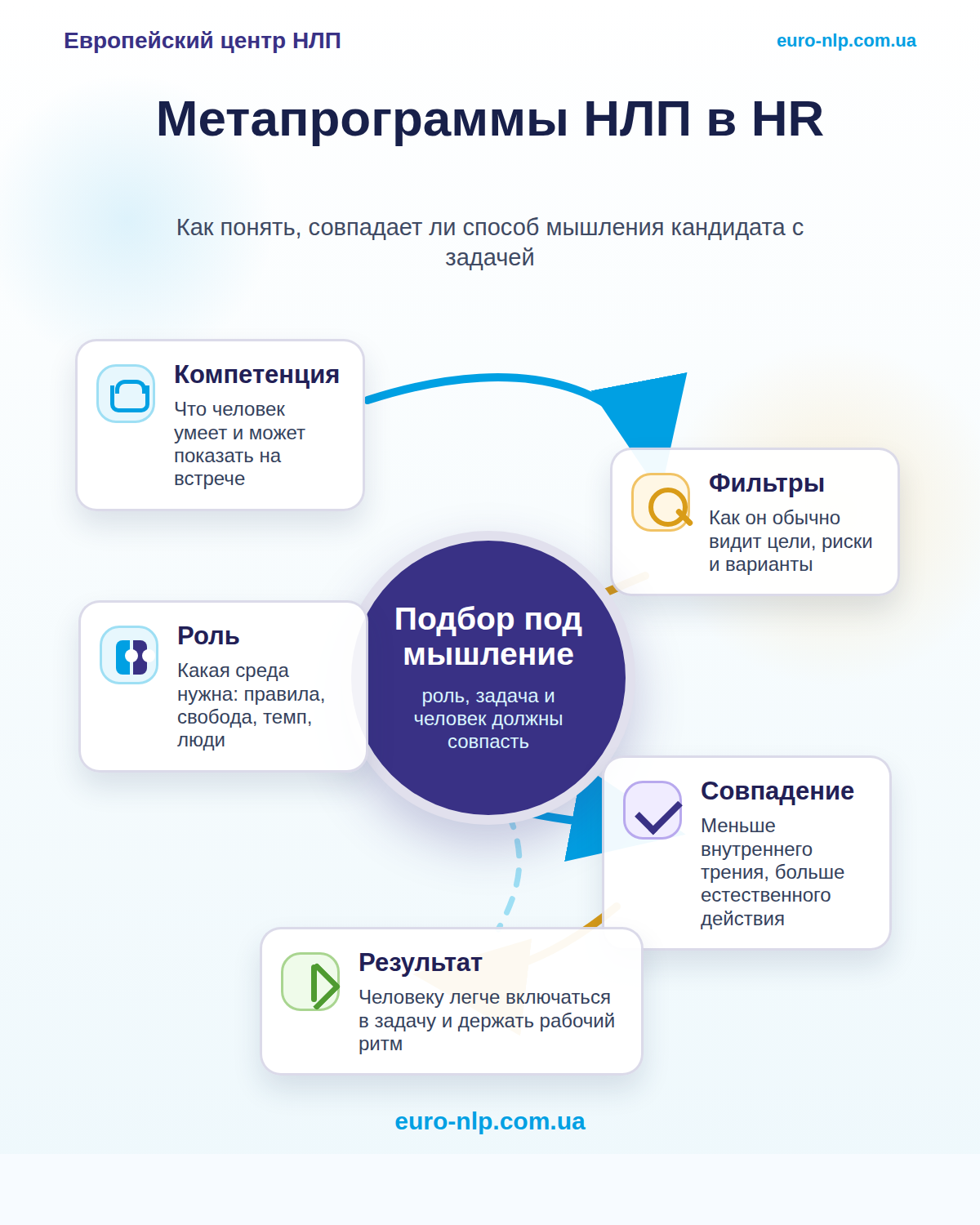
This is especially valuable when selecting people for a team, a project, or a role. A competency answers the question “can this person do it?” A metaprogram helps you see whether it will come naturally to them to act that way in real work. In this sense, the topic connects well with how NLP is applied in business and management.
What Metaprograms Reveal in HR
Metaprograms describe stable filters of thinking. One person notices risks faster; another notices opportunities. For some, it matters to move toward a goal; for others, to move away from a problem. Some rely on instructions; others rely on options and freedom of choice.
For HR, this is a practical clue. If a role requires constant initiative but the candidate works better within clear boundaries, conflict can start brewing right after hiring. Not because of a bad character – simply because the way of thinking didn’t match the task.
Competency and Habitual Way of Thinking
When a person has a competency, they can choose to show it or leave it aside. An interview usually checks whether the skill is present at all. But that’s not yet a guarantee that the person will apply it regularly, calmly, and without inner resistance.
Metaprograms reflect a person’s habitual thinking structure. If a candidate perceives tasks, people, and results in a certain way, they’ll most likely go on thinking in a similar way going forward.
A Quote from Kateryna Haiduchenko
And further – when we select people for a company, for projects, or for any task in a way that matches what they do to their thinking structure, we end up with motivated people who are genuinely good at getting their tasks done and achieving results. Simply because their thinking, as well as their perception and behavior, is aligned with the task at hand. It’s that simple.
Author: Kateryna Haiduchenko, NLP trainer, Kyiv
How to Use This in Hiring
The most careful approach is not to label a person, but to check their fit with the role. For this, it helps to:
- first describe what type of thinking the task actually needs;
- ask questions about real work situations rather than “correct” qualities;
- listen to how the candidate builds their answer: through goals, risks, rules, options, people, or results;
- compare the answers against the future work environment.
This perspective doesn’t replace professional assessment, test tasks, or a manager’s experience. It adds one more layer of understanding: how naturally this person is likely to do this particular job within this particular system.
Where to Study the Topic Further
If you’d like to explore this more broadly, start with the basic answer to the question what NLP actually is. For the practical side, the overview of NLP practices and techniques will be useful, and for work-related tasks, the material on applying NLP technologies in business.