European communication culture is a way of holding a conversation so that, after the meeting, what remains is clear agreements, respect for each side’s position, and room for long-term cooperation. This is especially visible in negotiation: what matters is not winning at any cost, but the quality of a decision that will hold up over time.
For business, training, and management tasks, this approach is valuable wherever you need to reach agreement with partners, clients, a team, or an international audience. It helps you speak more precisely, listen more carefully, and spend less energy overcoming hidden resistance.
What sets the European style of communication apart
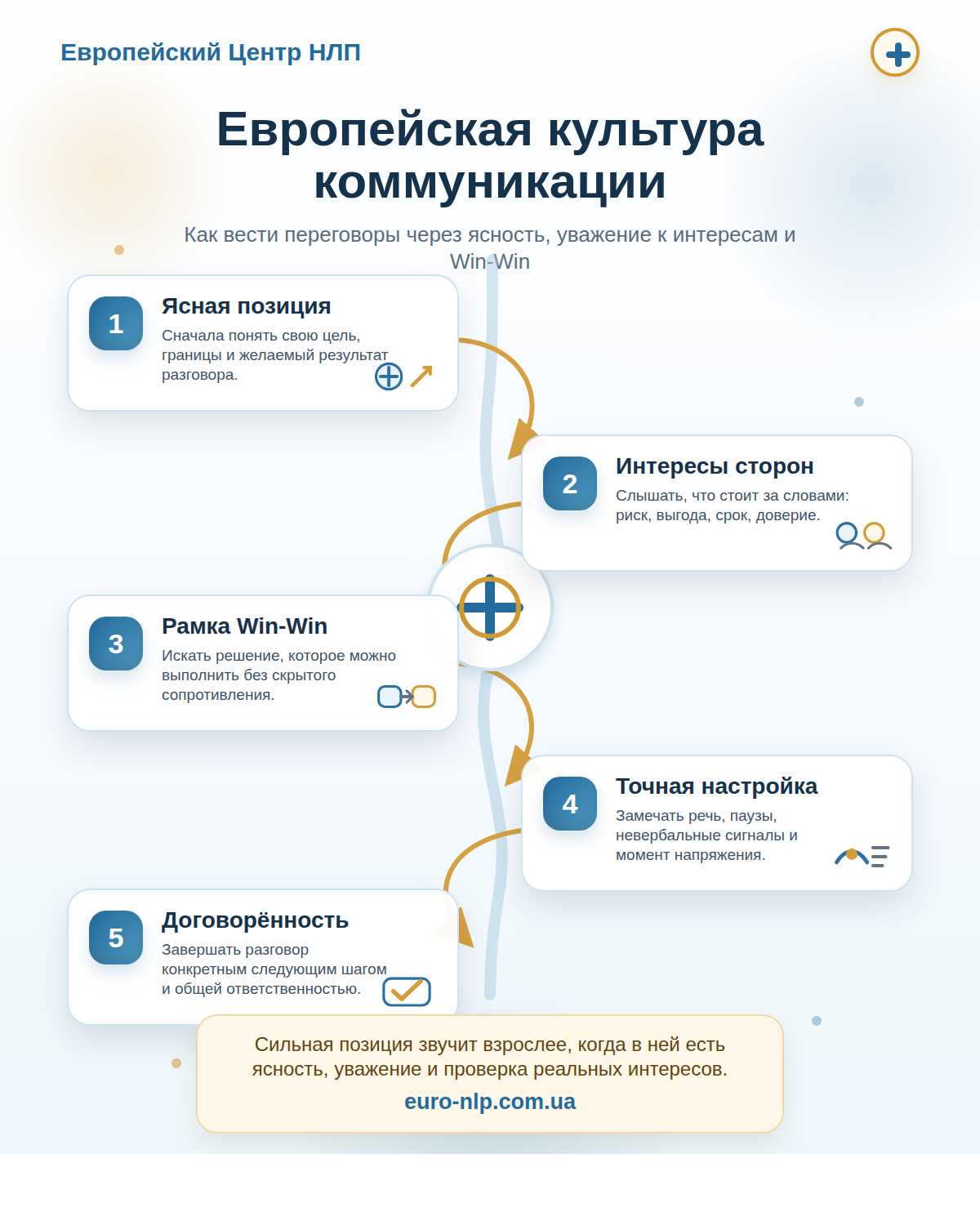
In the countries of the European Union, the US, and the UK, negotiation models are often built around a clear position, respect for boundaries, and a search for a Win-Win solution. This isn’t softness for its own sake. It’s a business calculation: when both sides understand their interests and see the benefit, cooperation lasts longer.
In post-Soviet business culture, a different scenario is still common: heavy pressure, a fight for concessions, an attempt to prove you’re right. This sometimes produces a fast result, but it often damages trust and closes the door to future deals.
Win-Win as a practical negotiating framework
The “Harvard” model of negotiation places the main emphasis on the interests of the parties rather than a rigid clash of positions. The Italian school of business communication also tends to focus on flexibility, contact, and precise wording. In both cases, negotiation stops being a clash of personalities and becomes joint work on a solution.
What matters within this framework
- Separate the person from the problem. You can argue about the options on the table and still maintain a normal connection.
- Listen for interests. Behind the position “we need a discount” there may be a budget, a risk, a deadline, or a fear of making the wrong choice.
- Check understanding. One short question often releases more tension than a long explanation.
- Record the agreements. Good communication ends with a clear next step.
How NLP helps here
NLP’s communication technologies provide tools for observing speech, nonverbal signals, reactions, and a person’s internal strategies. In a European business context, this is especially valuable, because influence is built not on pressure but on precisely calibrated rapport.
For example, in training you can break down how a person makes decisions, which words build trust, where resistance appears in a conversation, and how to shift an argument onto working ground. Good background reading for this approach includes our materials on what NLP is and on NLP practices and techniques.
Where this is applied
European communication culture isn’t needed only in international negotiations. It works in sales, management, HR, training, partner meetings, and difficult internal conversations. Wherever people depend on the quality of their agreements, communicative precision quickly becomes a competitive advantage.
Typical tasks
- build an argument for negotiations without pressure or manipulation;
- better understand a client’s or partner’s motives;
- reduce tension in difficult discussions;
- build long-term relationships instead of one-off concessions;
- turn conflict-driven conversations into agreements.
For business tasks, alongside this topic it’s worth looking at our material on NLP training for business and the training page NLP in negotiation and sales.
How to develop this kind of communication
It’s best to start simply: notice exactly what’s happening in a conversation. Where does someone agree on the surface but shut down inside? At what point does an argument sound convincing, and at what point does it start to feel like pressure? Which words help clarify an interest, and which trigger defensiveness?
At NLP training, these skills are practiced through exercises, role-played negotiations, feedback, and analysis of real situations. It’s a practical format: knowing the right principles isn’t enough — the point is to learn to hear live communication as it happens.
The main point
European communication culture rests on respect, precision, and taking responsibility for the outcome of a conversation. It doesn’t do away with a strong position. It makes that position more mature: less pressure, more clarity, and a better chance of the kind of cooperation people want to come back to.